Five papers published by NYU WIRELESS faculty and students ranked in the top 100 downloaded papers of IEEE publications and societies for July. This is a remarkable accomplishment, showing that the support from the NYU WIRELESS Industrial Affiliates and the NSF and NIH, and the tireless efforts by NYU WIRELESS graduate students and faculty, are …
The Federal Communications Commission (FCC) made history last month by unanimously voting to pass the proposal of the Spectrum Frontier Proceeding. With this move, it allocated unprecedented amounts of bandwidth for 5G wireless communications. “Carriers and entrepreneurs alike now have a true wireless fiber opportunity for fixed and mobile, and our work at NYU WIRELESS …
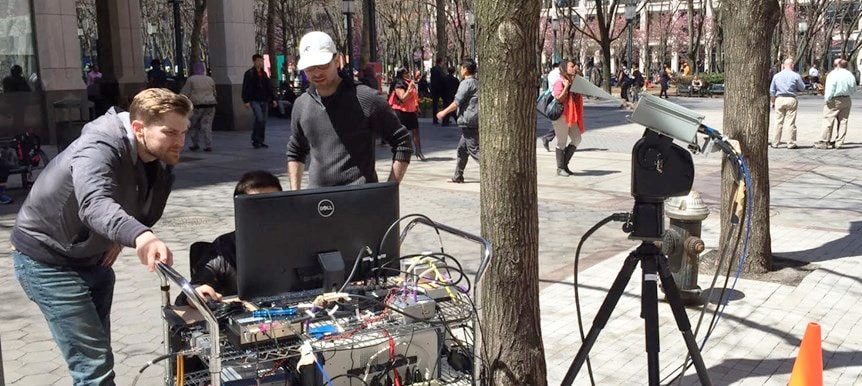
Mobile data consumption is soaring, but a broad set of technology advances is poised to transform what today’s smartphones and other wireless mobile devices can do—ushering in high-resolution video and fully immersive, 3-D environments. At the NYU Wireless lab in Brooklyn, students are testing prototype equipment—forerunners to next-generation phones—that are able to transmit a blazing …
Three years after he and his NYU students proved millimeter wave technologies worked, Ted Rappaport, Professor at NYU and the Founding Director of NYU Wireless, speaks with TIA NOW from the launch of the White House’s Advanced Wireless Research Initiative. Rappaport highlights the rapid progression, from proof of concept to reality, of millimeter wave and …
1. New spectrum frontiers Millimeter-length waves (mmWave) operate in the band of radio frequencies in the electromagnetic spectrum from 30 to 300 gigahertz (GHz). In the past, they have commonly been used in space communications, radio astronomy and remote sensing — but not in telecommunications because they are prone to deterioration in crowded settings. Recent …
Combined with the White House’s Advanced Wireless Research Initiative to spend $400 million over the next seven years to research and develop next-generation wireless technologies, last Friday was a “double rainbow” kind of day, as millimeter wave technology pioneer and NYU Wireless founding director Ted Rappaport put it. There’s all kinds of reasons for celebration, …
While most members of the general public probably do not take much notice of the Federal Communications Commission (FCC) and its rulings, the organization has a profound effect on how all of us interact with our radios, televisions, satellite and cable systems, and wireless devices. On July 14 the FCC voted affirmatively on a historic …
In one fell swoop, the FCC today put the U.S. in a 5G leadership position, voting 5-0 to approve its Spectrum Frontiers proceeding and make spectrum bands above 24 GHz available for 5G. FCC Chairman Tom Wheeler, noting his previous remarks on the proceeding, kept his remarks brief to avoid repeating himself. But he summed …
On July 14, 2016, the Federal Communications Commission (FCC) unanimously passed a proposal to free up vast amounts of new bandwidth in the underutilized high-band spectrum for the next generation of wireless communications (5G). The Spectrum Frontiers Proposal (SFP) will double the amount of millimeter-wave (mmWave) unlicensed spectrum to 14 GHz and create four times …

 2026 Open House
 2025 Brooklyn 6G Summit — November 5-7
 Sundeep Rangan & Team Receive NTIA Award